- Two countries bicker over a tiny island for years, then when nobody is looking, the island disappears.
- The secret lives of truffles: Slowly being unveiled?
- Artificial photosynthesis...what? Wait...what? I have no idea what to think about this, but apparently this involves frog foam. Oh, and solving the world energy crisis.
- Cool image of insect anatomy. I really want a poster of this.
- The ocean sorta drives everything about the atmosphere, and therefore climate. There's cause to be concerned that climate change will screw up the way the ocean currently functions. Fortunately, those concerns are someone lessened when the data shows everything is working normally.

Showing posts with label climate change. Show all posts
Showing posts with label climate change. Show all posts
Wednesday, March 31, 2010
Notes for March 31st


Wednesday, March 24, 2010
Riparian Restoration: More important than ever with climate change
 For people in the conservation/restoration community, trying to deal with climate change is a tough assignment. Years and years of training and conventional wisdom preaches the value of restoring habitat to a 'pristine' state. In the U.S., that usually translates into Pre-European settlement. However, the reality is that the pre-settlement environment may simply no longer exist. Even if those conditions do exist, there's no guarantee that it is even possible for those ecosystems to be recreated (some species may now be extinct or extirpated, or those genotypes may be extirpated, or the particular sequence of events that allowed those ecosystems to persist may never again occur).
 Getting past the goal of pristine restoration is not easy, in part because what goals are you going to use instead of pristine? Obvious (to many research ecologists) is the use of various ecosystem services or functions as replacement goals. Equally obvious is the conservation of particular endangered species. However, doing this without realizing the rapidity with which environmental conditions are changing is likely to result in poor results.
Seavy et al. (2009; full cite below) recently published a paper in Eco Restoration that discusses some of these issues in relationship to the restoration of riparian areas. They further argue that restoring riparian areas will provide benefits beyond the boundaries of the areas being restored. Specifically, they argue that restoring riparian areas will improve overall ecosystem resilience in the face of changing climate. Resilience (as defined by the authors) refers to the ability of an ecosystem to withstand disturbance without changing 'state', recover after disturbance, and the way an ecosystem responds to gradual changes. Resilience is a tricky concept (over a large enough time scale, every ecosystem is in constant flux), but for timescales relevant to wildlife management, this is probably a useful idea.
Essentially, Seavy et al. (2009) argue that restoring riparian areas is likely to improve the ecosystem resilience of surrounding areas because 1) riparian areas are naturally very resilient, 2) riparian areas improve connectivity between ecosystems (aquatic and terrestrial; along longitudinal migration corridors), 3) riparian areas are natural thermal refugia, and 4) there are lots of flood-related benefits to "natural" riparian areas. So lots of benefits, but achieving those benefits (in spite of major climate change) will require some fancy work. For instance, restoration plantings typically use seeds from species on-site or nearby. However, if environmental conditions are likely to change, then those species (or those genotypes) may not be successful, and noxious or non-native species would have the opportunity to invade.
Ok, so that all sounds really good. Some issues:
1) There's a real emphasis in this paper on riparian woodlands, but there are some places where woodlands are rare, or absent entirely. Should we plant woodlands along areas that haven't had them historically? I don't know, but I don't know if we should, or if we should even encourage it.
2) The authors talk about riparian areas being naturally resilient, but this is only really documented for persistence in the face of hydrologic variability (flood and, to a lesser extent, drought). I'm not aware of any literature documenting any particular resilience of riparian ecosystems to disturbances related to temperature, invasive species, pollution or eutrophication.
3) The primary benefit, that I can see, to prioritizing riparian restoration above other areas, is the reality that you are benefiting both terrestrial and aquatic habitats at the same time. However, I think this ignores the integrated nature of watersheds. I suspect that if you improve the non-riparian terrestrial components of a watershed, you're going to have similarly dramatic (if potentially different) positive effects on streams. I guess I'm not convinced that it is a good idea to make riparian restoration a priority without consideration of what else is going on in the watershed.
Having said that, the paper does make a compelling case that riparian areas are really important, and that we need to adjust how we restore them, and that some important questions need to be answered if we are going to be effective at restoring these ecosystems in the future.
Summary:
Restoration of riparian areas will likely provide a lot of benefits in light of the rapidly changing global climate, even beyond the strict borders of these areas. However, different techniques need to be employed to realize these benefits.
Seavy, N., Gardali, T., Golet, G., Griggs, F., Howell, C., Kelsey, R., Small, S., Viers, J., & Weigand, J. (2009). Why Climate Change Makes Riparian Restoration More Important than Ever: Recommendations for Practice and Research Ecological Restoration, 27 (3), 330-338 DOI: 10.3368/er.27.3.330
Monday, February 8, 2010
Notes For today
- The conservation value of airports. The reality is that the airport in the study is a 'high conservation area' just because the surrounding areas (New York) are so awful for everything that nothing survives. Even in the managed open areas surrounding the airport, the big benefactor of the 'conservation' area are insects. A group that is pretty adaptable and usually unwelcome.
- So they've built a better tomato. Kinda. The overwhelming frustration I have with genetically engineered food is not that it is GM. Rather, it is that it isn't being engineered for taste. I mean, look at the evidence they provide that the food is better: Pictures. Pictures don't taste good. I'm not sure how we can improve the taste, but it sure doesn't seem like anyone is even trying.
- Another reason to avoid shellfish: Apparently they cause amnesia.
- An interesting list of emerging conservation issues.
- Even among otherwise intelligent people, there seems to be core resistance to the idea that humans are actually causing climate change. People like to bring up all kinds of things (water vapor, the fact that CO2 is at very low abundance in the atmosphere, the temperature adjustments made to account for urbanization). I think this is happening because people don't want to believe that humans are messing everything up. Every piece of evidence demonstrating climate change is occurring ends up being undermined or ignored. Now that the evidence is becoming overwhelming, the response has been that this climate change is driven by 'natural' processes. Of course, there are still those who just want to believe the whole thing is a liberal conspiracy to mess with their sex lives.
Tuesday, January 19, 2010
Political Position and Carbon Footprint
So I stumbled across this link on reddit to a list of U.S. states CO2 emissions per capita and for reasons I'm not clear about, I immediately was reminded of this list.
And so I made the following chart.

Yes...there seems to be a relationship between political position and CO2 emissions. The exponential regression between those two variables is apparently statistically significant and has an R2 of 0.37 (the equation is 21.37-1.02^Conservativism = Per capita output). I say apparently because I'm only assuming I haven't screwed up the stats. [Editors note: Although apparently I did switch the axis labels...damnit!]
I would assume this is part of what drives the political polarization of how to respond to climate change.
And so I made the following chart.
Yes...there seems to be a relationship between political position and CO2 emissions. The exponential regression between those two variables is apparently statistically significant and has an R2 of 0.37 (the equation is 21.37-1.02^Conservativism = Per capita output). I say apparently because I'm only assuming I haven't screwed up the stats. [Editors note: Although apparently I did switch the axis labels...damnit!]
I would assume this is part of what drives the political polarization of how to respond to climate change.
Friday, February 1, 2008
Coal Plants in Kansas: Ashtray of the Midwest
Well, as everyone suspected, legislators in Kansas have taken up the gauntlet on behalf of Sunflower Electric Power Corp. to build a pair of new coal mines in Holcomb, KS (previous posts on this here and here). From the Lawrence Journal World:
Energy bills written in secret? No input from environmental groups or stakeholders outside of the companies that will be directly profiting? Doesn't this sound like a certain presidential administration's Energy Task Force?
The bill that has been written is being described by intelligent people as a poor excuse for a compromise between the coal industry and environmental concerns. Diane Silver (from In This Moment) quotes Gov. Sebelius's press release:
Kansans need to let the legislature know how they feel about this issue. Here is the website where you can find your state representatives. Send them a letter.
[Hat tip: In this Moment]
Bills addressing the top environmental issue of the legislative session were written in secret by those who support construction of two coal-burning power plants in western Kansas.
Energy bills written in secret? No input from environmental groups or stakeholders outside of the companies that will be directly profiting? Doesn't this sound like a certain presidential administration's Energy Task Force?
The bill that has been written is being described by intelligent people as a poor excuse for a compromise between the coal industry and environmental concerns. Diane Silver (from In This Moment) quotes Gov. Sebelius's press release:
Under the current bill, any coal plant, from anywhere in the country, applying for a permit and meeting the very minimum standards established by the EPA would have to be given a permit. It wouldn’t matter whether Kansas needed the energy or not. All the coal plants that have been denied permits or withdrawn applications in other states would be knocking at our door.As the Sierra Club's Bruce Nilles puts it, this would make Kansas the ashtray of the midwest:
“Kansas is the first state that we know that is proposing to accelerate global warming,” Nilles said. “That is a real black eye for Kansas to be the one state right now proposing to accelerate global warming.”Ok, that's what is happening, but what does this all mean? Well, basically it means that the Kansas legislators are not interested in listening to the interests of Kansas citizens. Earlier polls have indicated Kansans are heavily opposed to the construction of the coal plants, so why do elected officials continue to push an idea that is clearly unpopular? The reason is, of course, money. These legislators are guided only by the unholy dollar. Anything that is perceived, real or imagined, to be financially beneficial is going to be ram-rodded through the legislature.
Kansans need to let the legislature know how they feel about this issue. Here is the website where you can find your state representatives. Send them a letter.
[Hat tip: In this Moment]
Monday, January 7, 2008
Wind Farms
I'm a big proponent of alternative energy solutions. On a broad scale, I think producing energy that doesn't rely on simply burning fossil fuels, combined with a reduced consumption, is the only long-term solution to global climate change issues.
However, global climate change is only one step of the environmental issues we're facing as a society. We're also threatening the healthy functioning of ecosystems by eliminating species through habitat destruction, introducing new species, etc.
Wind power is one of the most cost-effective alternatives to coal available today. The physics are simple, the mechanics are well-understood, and the supply of wind is abundant in many locations. Indeed, wind power is growing so fast the suppliers of turbines are having a hard time keeping up. The overall picture is that wind power is going to become an increasingly important part of our energy budget.
The downside? Like just about everything else we push up into the sky, wind turbines may take a pretty heavy toll on the bird populations. This paper suggests that most of the birds killed by a Minnesota wind farm were migrants, and in case anyone forgot, we have a treaty that covers migrants. Overall though, I haven't been able to find a lot of hard data on the magnitude of effects on birds, but as I've mentioned before, I have terrible journal access here. I'll be at the library later this week and I'll have to see if I can find out more then.
There seems to be some inherent reason to believe that this might be similar to what happens with bird-kills around cell and radio towers. The basic idea with the towers is that lights on the towers reflect off clouds, creating a "false dawn" that the birds respond to en-masse. The response? Flying around in circles while waiting for the sun to come up. Unfortunately, flying around a 400 foot tower supported by guyed wires isn't a great idea, even for birds with as much dexterity as a sparrow. Of course, the wind turbines don't have wires supporting them (at least, not as many), but the swinging blades might pose a similar hazard.
I mention this because a battle over the environmental impacts of wind is raging down in Texas. Essentially, the use of wind is going to lead to whole new areas of land being given over to energy production that were previously being used for something else. I think the large-scale, long-term benefits of increasing wind production and subsequently decreasing coal/petroleum use probably outweigh the impacts on migratory birds, but I'm not sure. I'm not sure enough information about the effect of wind turbines on bird populations is even known to answer that question.
Any thoughts?
However, global climate change is only one step of the environmental issues we're facing as a society. We're also threatening the healthy functioning of ecosystems by eliminating species through habitat destruction, introducing new species, etc.
Wind power is one of the most cost-effective alternatives to coal available today. The physics are simple, the mechanics are well-understood, and the supply of wind is abundant in many locations. Indeed, wind power is growing so fast the suppliers of turbines are having a hard time keeping up. The overall picture is that wind power is going to become an increasingly important part of our energy budget.
The downside? Like just about everything else we push up into the sky, wind turbines may take a pretty heavy toll on the bird populations. This paper suggests that most of the birds killed by a Minnesota wind farm were migrants, and in case anyone forgot, we have a treaty that covers migrants. Overall though, I haven't been able to find a lot of hard data on the magnitude of effects on birds, but as I've mentioned before, I have terrible journal access here. I'll be at the library later this week and I'll have to see if I can find out more then.
There seems to be some inherent reason to believe that this might be similar to what happens with bird-kills around cell and radio towers. The basic idea with the towers is that lights on the towers reflect off clouds, creating a "false dawn" that the birds respond to en-masse. The response? Flying around in circles while waiting for the sun to come up. Unfortunately, flying around a 400 foot tower supported by guyed wires isn't a great idea, even for birds with as much dexterity as a sparrow. Of course, the wind turbines don't have wires supporting them (at least, not as many), but the swinging blades might pose a similar hazard.
I mention this because a battle over the environmental impacts of wind is raging down in Texas. Essentially, the use of wind is going to lead to whole new areas of land being given over to energy production that were previously being used for something else. I think the large-scale, long-term benefits of increasing wind production and subsequently decreasing coal/petroleum use probably outweigh the impacts on migratory birds, but I'm not sure. I'm not sure enough information about the effect of wind turbines on bird populations is even known to answer that question.
Any thoughts?
Thursday, January 3, 2008
Kansans = Awesome
Not only did the Kansas Department of Health and the Environment make Kansas the first state to deny the construction of a new power plant based solely on greenhouse emissions, it turns out Kansans are totally on-board. From a poll paid for by the Land Institute out of Salina:
Predictably, the Kansas State legislators from the Western district are unwilling to believe the results.
For the record, the people of Kansas are seeing right through the non-sense that has been thrown at them from the various agencies who have a political or financial stake in building an unnecessary coal power plant.
By a 2:1 margin (62% agree, 31% disagree), Kansas voters agree with the Kansas Department of Health and Environment's decision to block constrcution of the two new coal burning plants near Holcomb, Kansas. [cite]
Predictably, the Kansas State legislators from the Western district are unwilling to believe the results.
Yes, well when you're only talking to Sunflower Electric and other entities with a financial stake in the issue, I suppose you might get that impression. Note the key here, Mr. Morris is solely saying that by virtue of the result the poll must be inaccurate. I know the Bush Administration has always taken the position that facts which contradict them are inherently suspect. I am disappointed to learn that philosophy is trickling down to local politicians.
"I just can’t imagine that would be an accurate poll,” [Senate President Steve Morris, a Hugoton Republican] said. “Virtually everyone I’ve talked to has been concerned about the decision.” [cite]
For the record, the people of Kansas are seeing right through the non-sense that has been thrown at them from the various agencies who have a political or financial stake in building an unnecessary coal power plant.
Thursday, December 20, 2007
Greenhouse Gas Emissions
This is hard to believe. The EPA has denied California the opportunity to set tougher emission standards than the federal government. Here's what EPA head Stephen Johnson said:
Um. What? What 'clear national solution' is he talking about? I've been watching the environmental idiocies of this presidency for the past 7 years, and I haven't seen a "clear national solution" for anything this administration has done. Is the solution "Do nothing."?
I can't help but wonder if this is the beginning of an attempt by the Bush administration to override the KDHE's decision to deny a permit for a new coal plant. I mean, really, isn't the KDHE's rejection of the permit on the basis of CO2 emissions essentially the same thing as California independently reducing car emissions?
The actions of the EPA and the government on this issue have, over the past 7 years, bordered on absolute lunacy. This appears to be a continuation of that trend.
"The Bush administration is moving forward with a clear national solution — not a confusing patchwork of state rules," Mr. Johnson told reporters on a conference call. "I believe this is a better approach than if individual states were to act alone."
Um. What? What 'clear national solution' is he talking about? I've been watching the environmental idiocies of this presidency for the past 7 years, and I haven't seen a "clear national solution" for anything this administration has done. Is the solution "Do nothing."?
I can't help but wonder if this is the beginning of an attempt by the Bush administration to override the KDHE's decision to deny a permit for a new coal plant. I mean, really, isn't the KDHE's rejection of the permit on the basis of CO2 emissions essentially the same thing as California independently reducing car emissions?
The actions of the EPA and the government on this issue have, over the past 7 years, bordered on absolute lunacy. This appears to be a continuation of that trend.
Tuesday, December 4, 2007
Photos: SETAC in Milwuakee
For some reason my pictures of catching Neosho Madtoms are not coming up on this computer, but I wanted to put some pictures up anyway. So here's some pics from my recent trip to SETAC in Milwaukee. (captions below the pic)

 Apparently there's a duck theme to the riverwalk.

Unfortunately the closest thing we saw to an actual duck was this chair floating down the river. I also have pictures of traffic cones in the water. Beautiful.
 This is recovered treasure from a sunken Spanish ship. The weight of the silver block is supposed to be so great that you can't run away with it, but there were still two guards with tasers there.
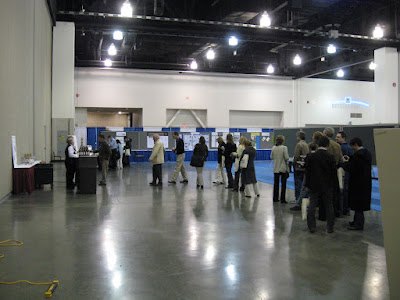 This was the beer line just before 5 30 when the open bar opened.

What? That doesn't look like a scientific conference! How'd that get in here?

Yes. I'm wearing shorts in Milwaukee. In November. Has anyone heard of this whole 'climate change' thing?
This is the Milwaukee River (I think). There's a nice river-walk behind a bunch of buildings in the downtown. The first part of the week was so nice we walked along here a couple of times during lunch. Later in the week it got extremely cold and windy, so I guess we haven't gotten to the point where it is warm all year yet.
This is the Milwaukee River (I think). There's a nice river-walk behind a bunch of buildings in the downtown. The first part of the week was so nice we walked along here a couple of times during lunch. Later in the week it got extremely cold and windy, so I guess we haven't gotten to the point where it is warm all year yet.
 Apparently there's a duck theme to the riverwalk.
Unfortunately the closest thing we saw to an actual duck was this chair floating down the river. I also have pictures of traffic cones in the water. Beautiful.
 This is recovered treasure from a sunken Spanish ship. The weight of the silver block is supposed to be so great that you can't run away with it, but there were still two guards with tasers there.
 This was the beer line just before 5 30 when the open bar opened.
What? That doesn't look like a scientific conference! How'd that get in here?
Wednesday, November 28, 2007
Cool Journal Articles: CO2 Enrichment and Crayfish

I have a lot less time to read good journal articles than I used to, and KDWP has incredibly limited access to on-line journals, so I am just now getting to the latest issue of the Journal of the North American Benthological Society (JNABS; which is actually listed as December 2007). I feel like JNABS is a vastly underrated journal, but I have to admit that I’ve published two papers there, so I may not be entirely without bias.
At any rate, there are several very interesting articles in this issue, and I hope to highlight them all on this blog. The most interesting/amazing by far (in my mind) is one by John Kominoski and others (see full citation below #1). I just did a quick google-search, and apparently Kominoski has his own google-page (you can get a .pdf of this article from there).
Ok, so let’s talk about this paper a little. Oddly enough, this paper integrates subjects I find very interesting: dissolved organic matter (DOM), periphyton and crayfish. The basic premise of the paper is that as CO2 levels in the atmosphere rise, the organic chemistry of plants is going to change. This has lead to a widespread idea that herbivores feeding on these elevated CO2 plants will be less able to extract needed nutrients. My friend and collaborator Paul Frost has published one paper exploring the stoichiometry behind this, but he certainly isn’t the only one (see his citation below #2). The basic idea is that as you increase the CO2 in the atmosphere, you increase the amount of carbon in the leaves/tissues of plants. That seems great, since it means more productivity when measured in terms of energy.
Unfortunately, it also means less (by percent weight) of other essential elements (i.e., nitrogen or phosphorus). So more CO2 in the atmosphere means you have to eat more food to get the same amount of nutrients (as in a lower CO2 atmosphere). At least, that’s one theory with some support.
The kicker is that the additional C in those leaves in plants may not just be adding nutrient-poor bulk to the plant, it may be in the form of compounds that are actively toxic. That’s what Paul Frost found in the 2005 paper I mentioned earlier. His little bugs eating elevated-CO2 leaves were leaking essential nutrients.
So back to the Kominoski paper. Kominoski (or Nancy Tuchman or one of the authors) got the idea that these leaves aren’t just a direct food source to detritivores and herbivores, they are also an indirect food source to the base of the aquatic foodweb (the biofilms on rocks, often referred to as periphyton). Here’s where the DOM story comes into play. See, DOM is a fantastically important component of most aquatic ecosystems, controlling light penetration through the water column, the bioavailability of heavy metals and nutrients, has a huge effect on the pH of water, and is a ‘food’ source for bacteria and algae. DOM is just organic matter, which is a pretty broad category, and it comes from a lot of different places (animal excretion, algal release, bacterial release), but one of the biggest sources in temperate forested streams (and lakes) is leaves.
That’s right, leaves. Leaves falling into streams or lakes or wetlands leach organic compounds. You can probably imagine where this is going. Kominoski et al. found that the DOM leached out of his CO2 enriched leaves caused a different biofilm to develop than the DOM leached out of leaves raised in ambient conditions. That difference proved to be one that crayfish (a hugely important species in many aquatic ecosystems) could detect, and avoid. The implication that Kominoski et al. draw is that crayfish in a CO2 enriched world will possibly stop eating periphyton and start eating other, more nutrient-rich sources of food preferentially. Say goodbye to smaller macroinverts!
One key implication of this paper is that climate change isn’t just going to cause ecological havoc because of changes in temperature or rainfall; simply changing the CO2 content of the atmosphere will have dramatic and subtle effects on the biosphere.
- I’m curious to see on how many more posthumous papers the legendary Bob Wetzel will be a co-author. Will this be the last one? Is John Kominski (who seems pretty cool) the last first author with Wetzel as a co-author?
Subscribe to:
Posts (Atom)